

Insects ‹‹ Go Back
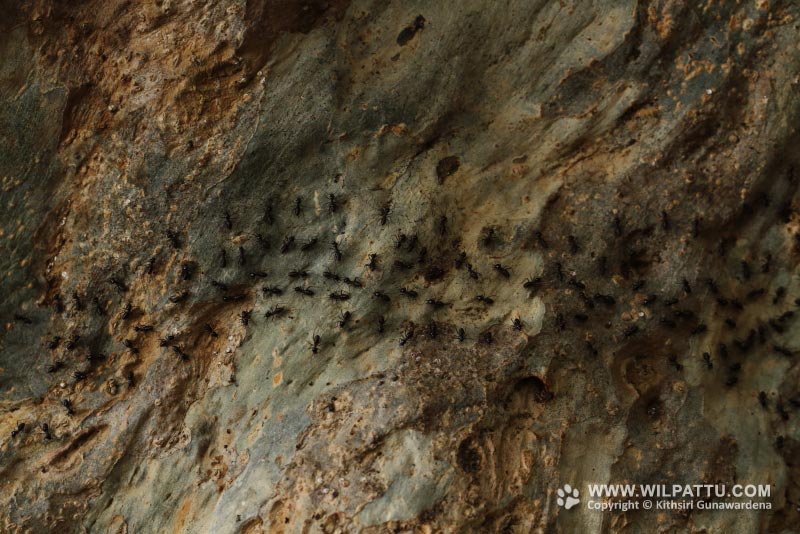
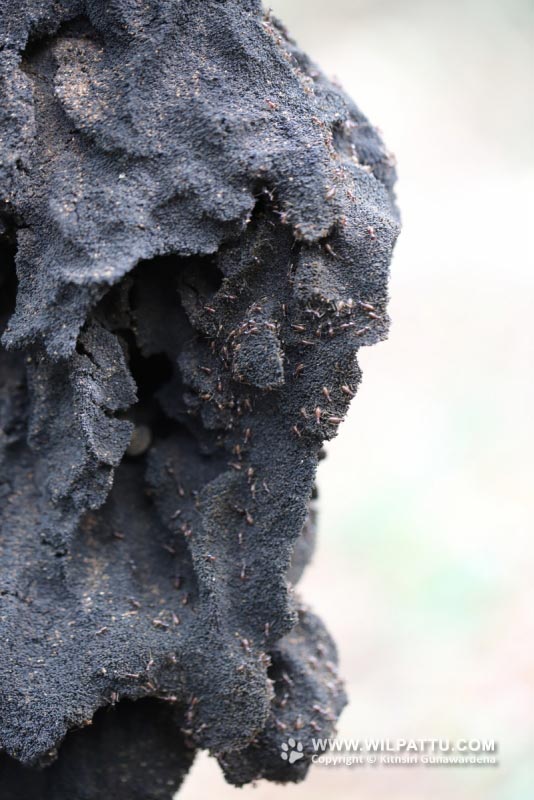
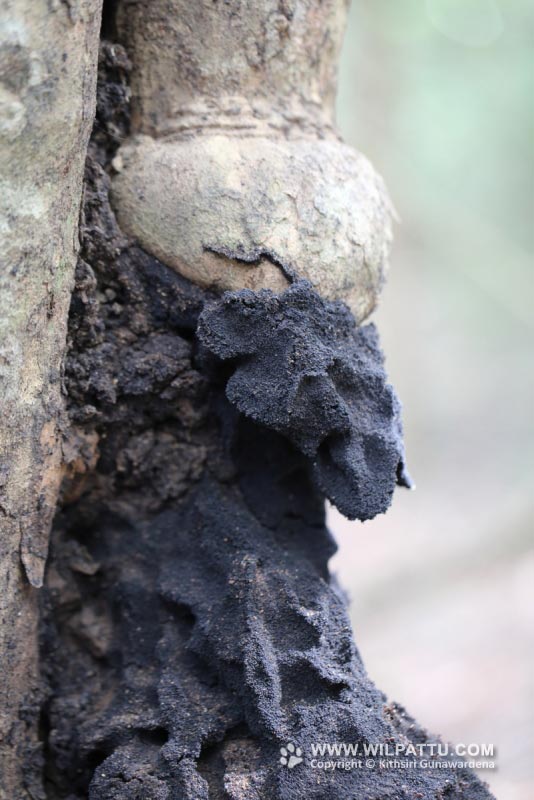
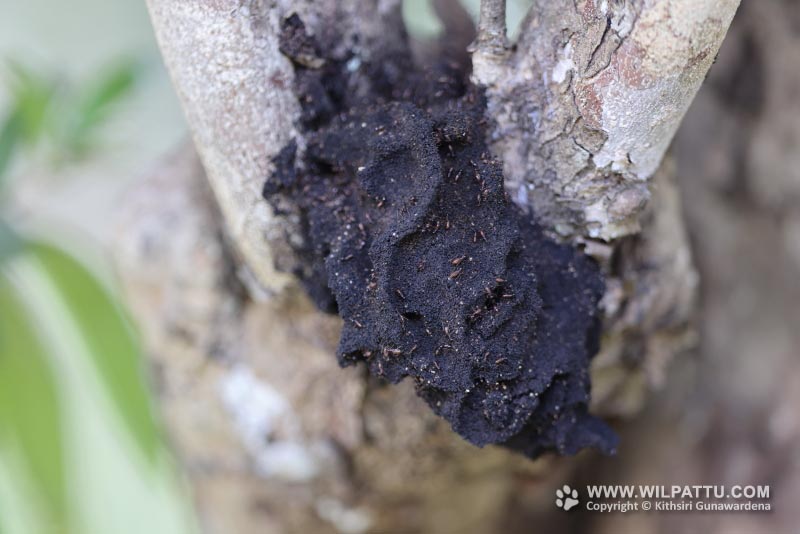
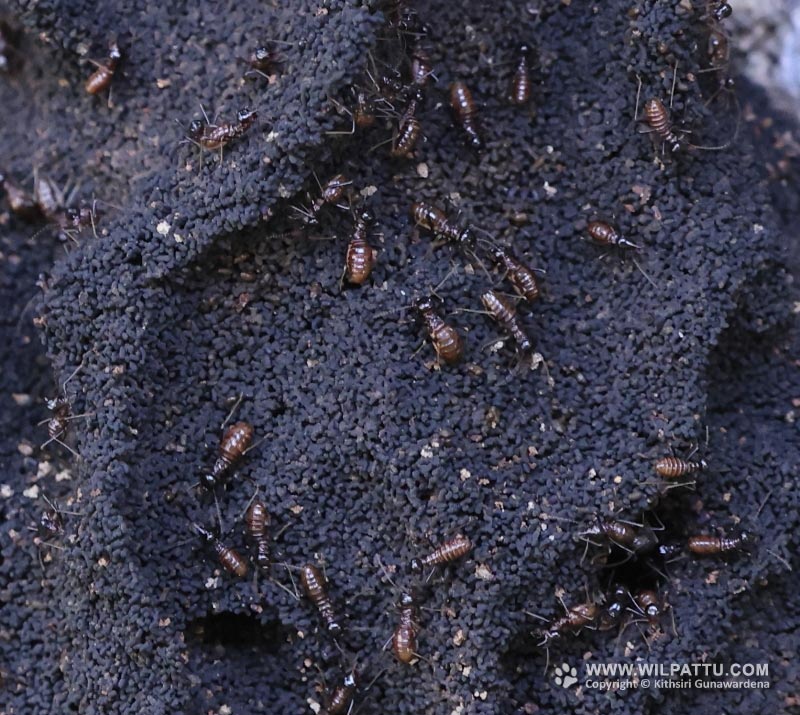
The Black Arboreal Termite is a fascinating arboreal species that builds its distinctive black nests in tree crevices. These nests are commonly seen on mature trees in Wilpattu. Unlike many termite species, it does not feed on structural timber. Instead, it feeds exclusively on lichens, fungi and blue-green algae. Workers build the nest from a mixture of excreted faeces, saliva and decomposed forest-floor detritus. Dark, undigested plant compounds such as lignin and other pigments accumulate in their gut, staining the organic waste materials and gives the nest its black colour. The nest’s outer shell forms a hard protective crust against rain and wind, while the sponge-like interior contains nursery galleries arranged in an intricate, fragile maze of thin walls. This lightweight structure allows good air circulation and helps maintain a stable temperature. Deep inside the nest is a heavily fortified chamber that protects the lifelong king and queen from birds, ants and lizards.
Each colony has a queen whose sole role is to lay thousands of eggs. Unlike ants and bees, where the male dies soon after mating, termite colonies also have a king who lives with the queen for life and continues to mate with her. Both king and queen depend entirely on the workers, who feed and groom them throughout their lives. The workers also carry the eggs to nursery chambers within the tree nest.
In Sinhala, these termites are called “Geriya,” and their nest material, used in traditional medicinal preparations, is known as “Geri Pas.”
Because they do not feed on wood or timber, they do not damage the trees they nest on or timber-based manmade structures. Their nests are lightweight, cardboard-like structures built in tree crevices. Their dark exoskeleton acts as a sun shield, helping protect them from sunlight. In the late afternoons and evenings, they march out of their nests in long columns to forage on lichens, which is why they are known as “Processional Termites.” By feeding on surface lichens, they serve as nature’s scavengers. I have observed these long columns on tree trunks and across park roads, sometimes with soldier termites standing guard as the workers pass.
A Black Arboreal Termite colony begins when a winged male and female leave their parent nest, shed their wings, mate and find a secure place in a tree to establish a new colony. Although thousands may fly out, only a few pairs survive long enough to start one. These seasonal swarms of winged individuals are common among many ants and termites. Most are eaten by birds, reptiles and small mammals, but their large numbers increase the chances for a few to find a mate and reach a safe nesting site.